Closing Auction Session (CAS)
The Closing Auction Session is SEBI's method for determining the closing price of Category I stocks, those with active futures and options contracts on NSE and/or BSE. For these stocks, continuous trading stops at 3:15 pm. Buy and sell orders are then collected over a fixed window and matched at a single equilibrium price, known as the Indicative Equilibrium Price (IEP). All other listed stocks continue to use the earlier volume weighted average price method for the last thirty minutes of trading.
Identifying a CAS Stock
Any stock in your CubePlus watchlist that falls under CAS carries a small symbol next to its name. Hovering the cursor over that symbol brings up a note confirming the stock is part of the Closing Auction Session. This is the quickest way to tell, at a glance, which of your tracked stocks will move into the auction mechanism as the market approaches close.
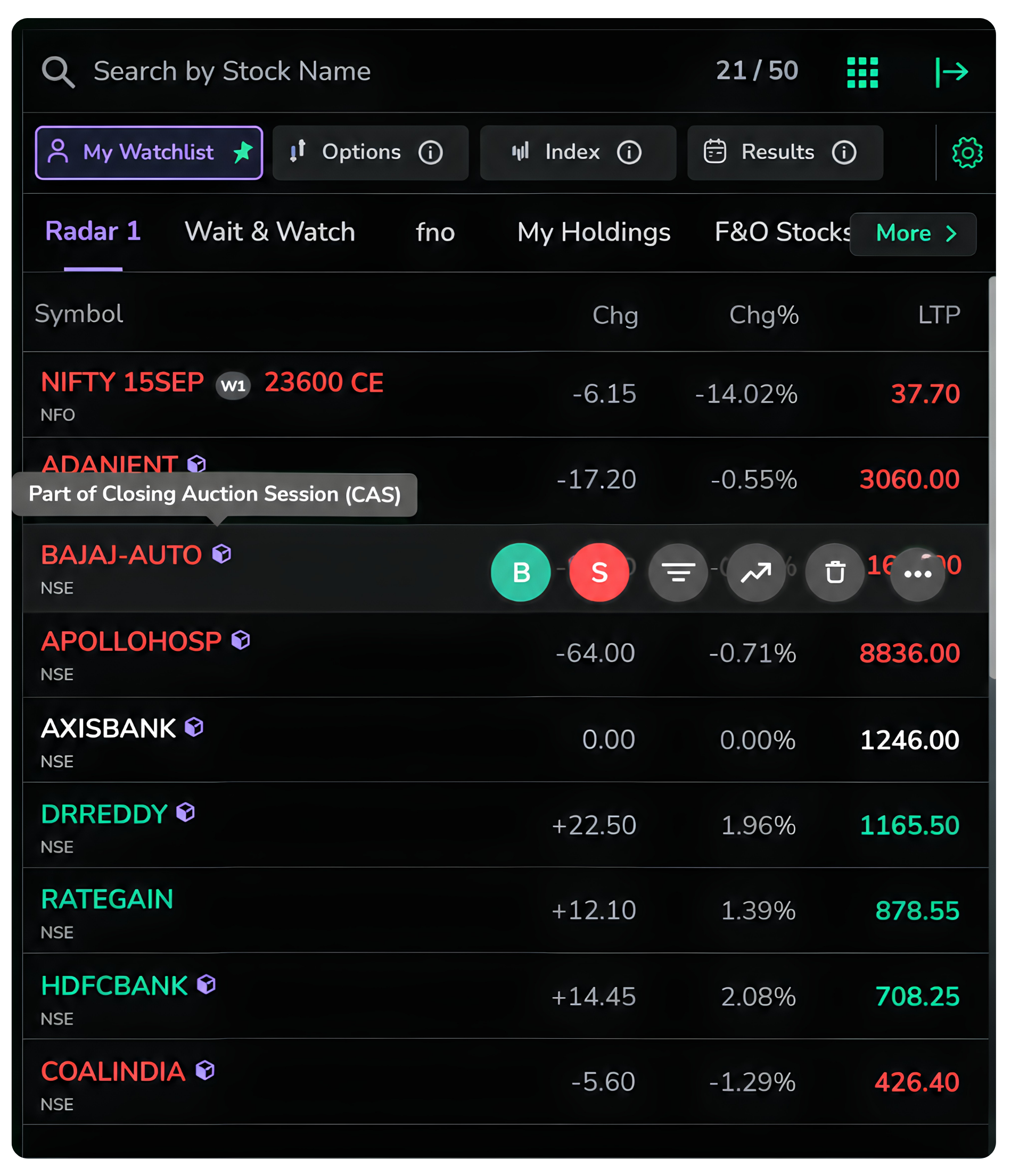
Hover over the CAS symbol next to a stock's name on the watchlist to see confirmation.
CAS Data on CubePlus
CubePlus surfaces CAS data in four places. Each gives the same core figures (Reference Price, Indicative Close, and Imbalance Quantity) in a different context depending on where you are in the platform.
Performance Panel
Clicking on a CAS stock in the watchlist opens its Quote Overview page, with Market Depth and the Performance panel placed side by side. The Performance panel shows the day's standard price data alongside the CAS-specific figures. These CAS figures will not appear until continuous trading stops at 3:15 pm on the trading day.
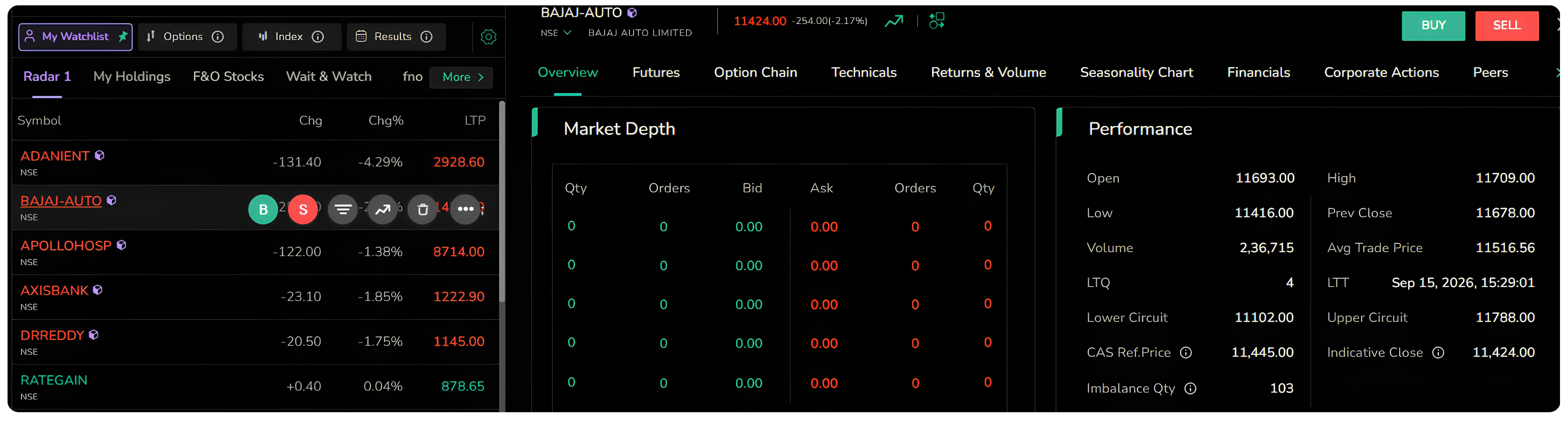
Quote Overview page for a CAS stock, with the Performance panel visible on the right.
The CAS-specific fields in the Performance panel are defined below:
| Term | What it shows |
|---|---|
| CAS Reference Price | The VWAP of trades between 3:00 pm and 3:15 pm. It anchors the auction and sets the permitted price range for the session. |
| Indicative Close | The price at which the maximum quantity can currently be matched, based on orders received so far. It moves as fresh orders enter the auction. |
| Imbalance Quantity | The buy or sell quantity left unmatched at the current IEP, indicating whether demand or supply is dominating the auction. |
Hovering over the small info icon beside any of these labels brings up a short explanation on the screen. There is no need to leave the page to check what a figure means.
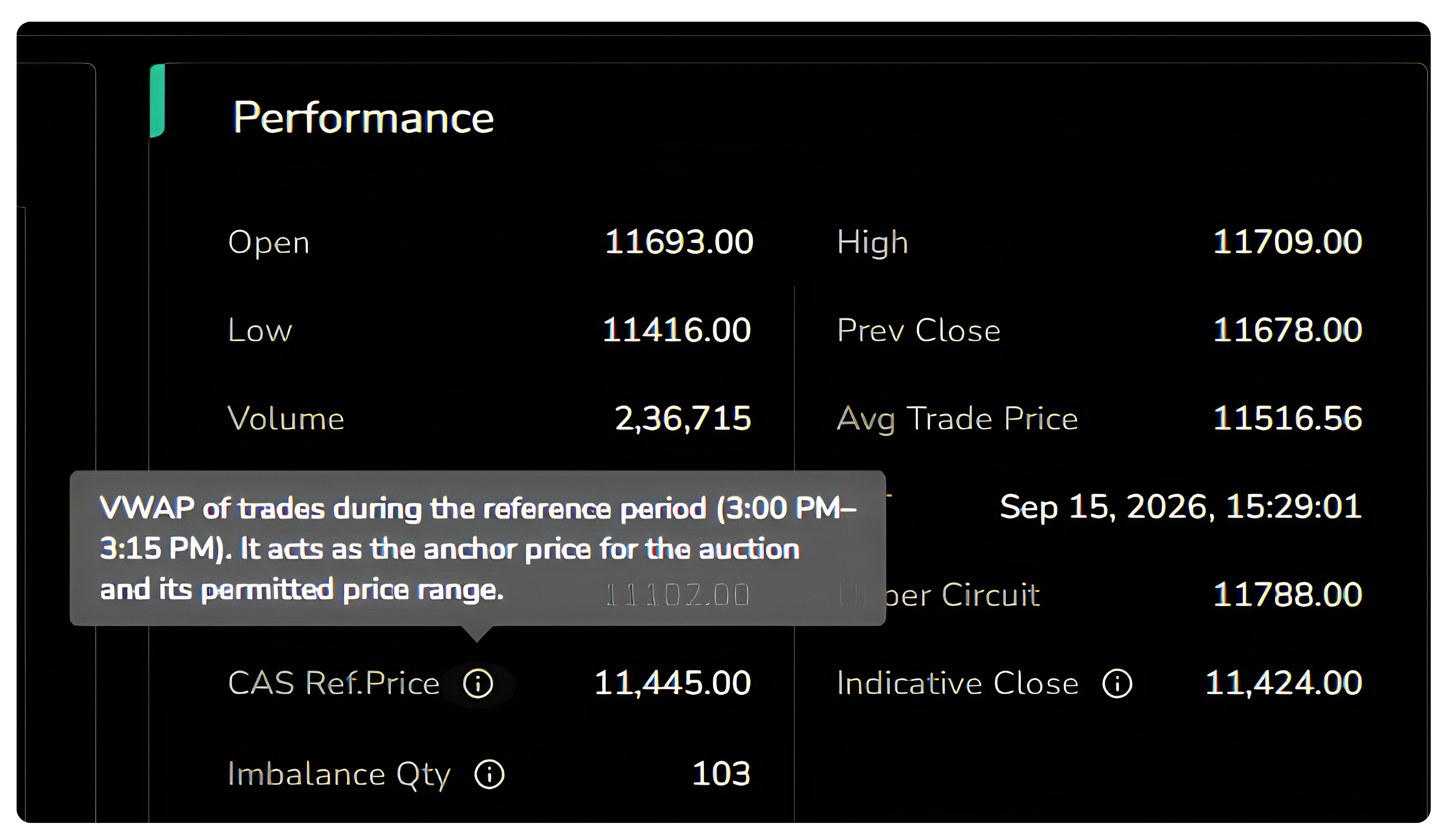
Hovering over the info icon next to Reference Price on the Performance panel.
Market Depth
Hovering over a CAS stock on the watchlist and opening Market Depth shows the bid and ask order book alongside the Reference Price, Indicative Close and Imbalance Quantity in a single view, without navigating to the full Quote Overview page.
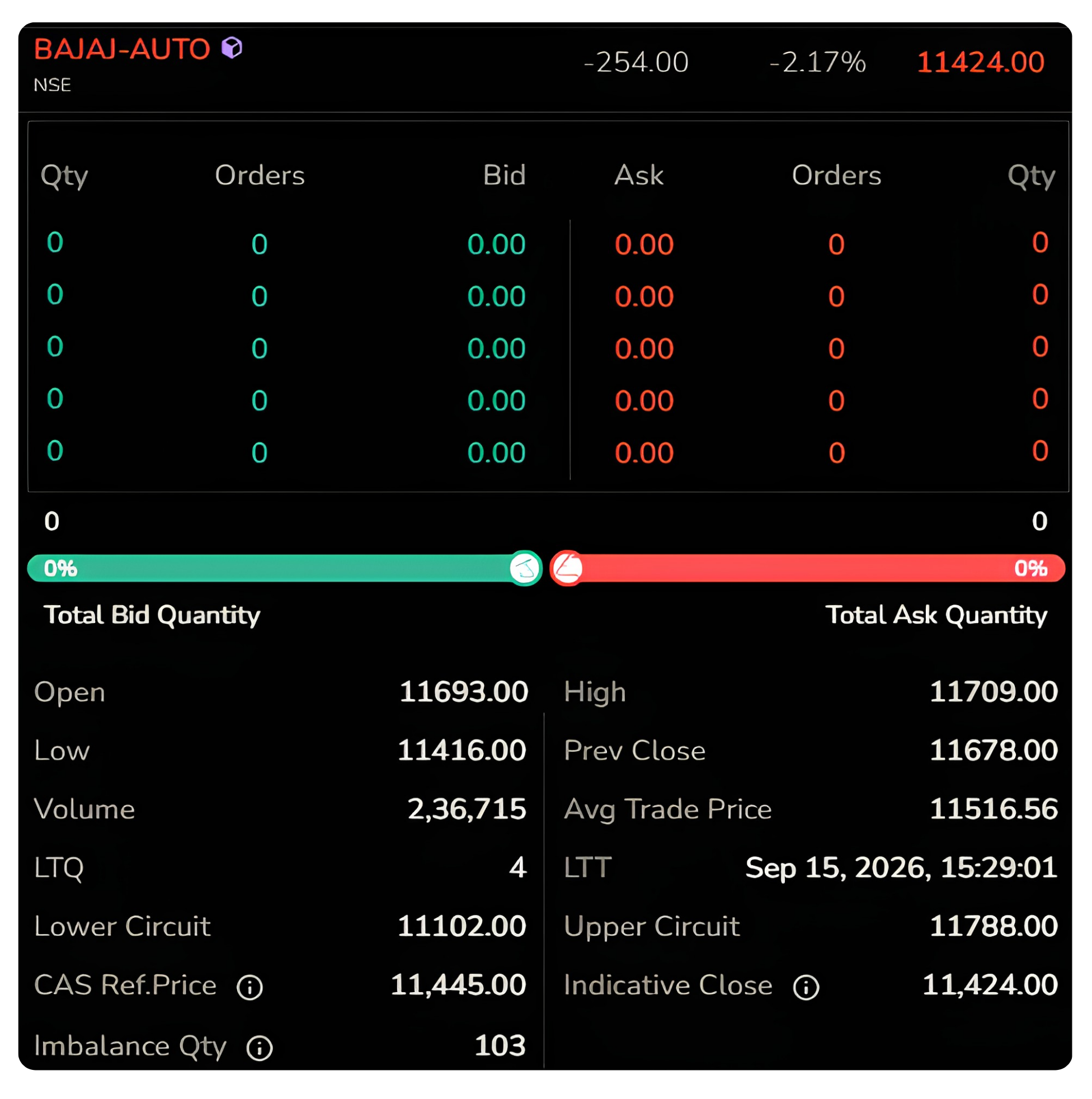
Market Depth opened from the watchlist, with CAS figures below the order book.
Expanded Watchlist
The watchlist can be switched to a full table layout, in which Reference Price, Indicative Close, and Imbalance Quantity appear as columns across all tracked CAS stocks. This allows several stocks to be scanned at once instead of opening each one individually.
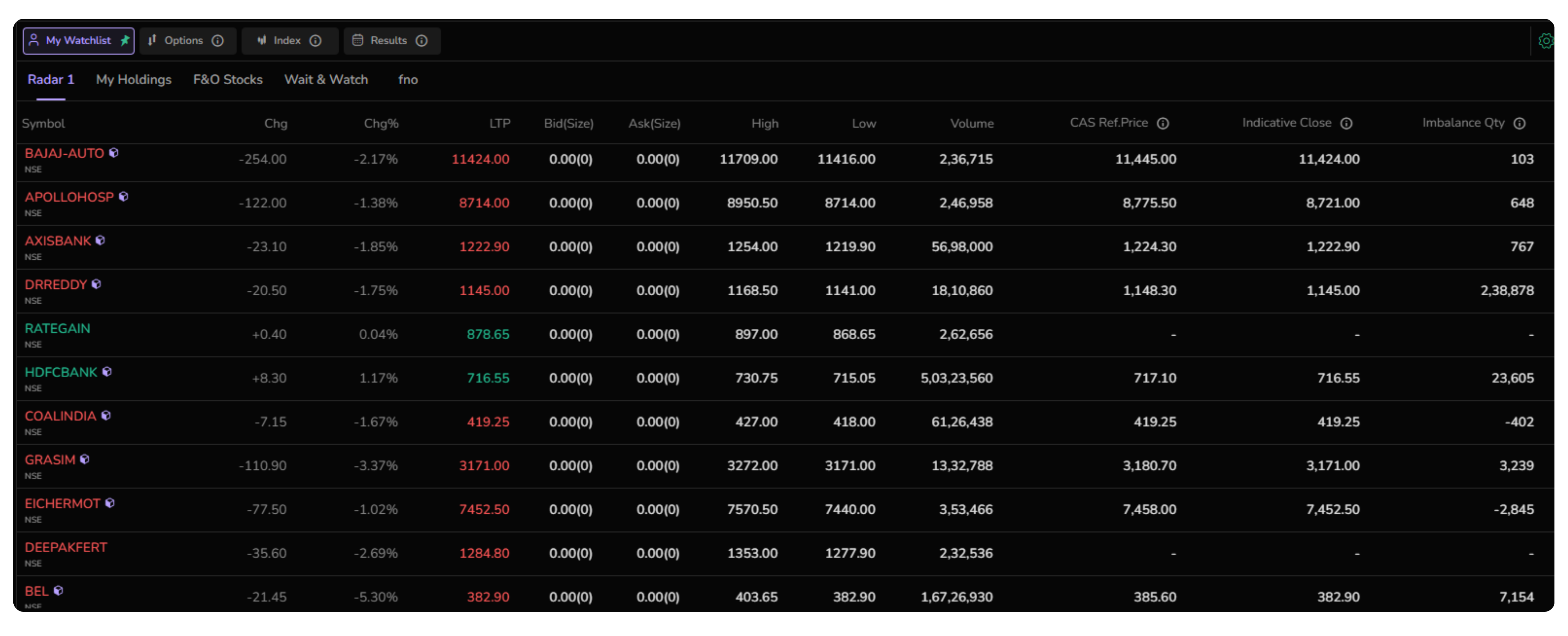
The expanded watchlist view, with CAS columns running across every tracked stock.
Order Pad
While placing an order for a CAS stock, clicking on depth within the order pad pulls up the market order book alongside the day's price range and the Reference Price, Indicative Close, and Imbalance Quantity. This puts the relevant auction data in front of you at the point of order entry.
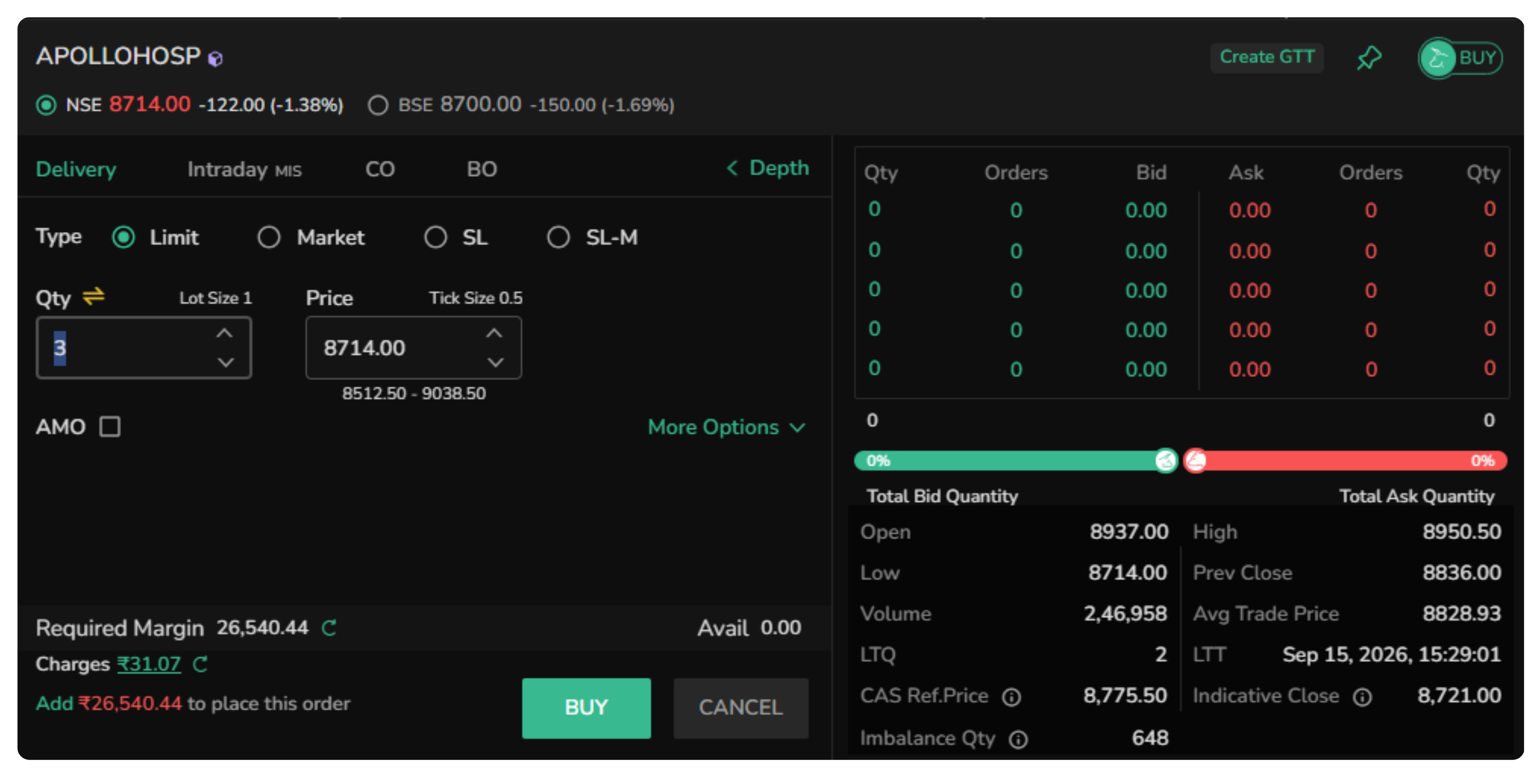
The order pad with depth expanded, showing CAS data beside the order entry fields.
Reference Price and the Price Band
The Reference Price for a CAS stock is fixed using the VWAP of trades between 3:00 pm and 3:15 pm. The auction window then operates within a band of ±3% around this reference price. Orders placed outside this range are not accepted during the session.
For stock and index futures, a separate reference price applies after 3:15 pm. This reference price is calculated independently of the underlying cash stock's reference price; it is not derived from the same VWAP figure. Anyone tracking both the cash and derivative legs of the same stock through the closing session should keep this distinction in mind, since the two reference prices are not interchangeable.